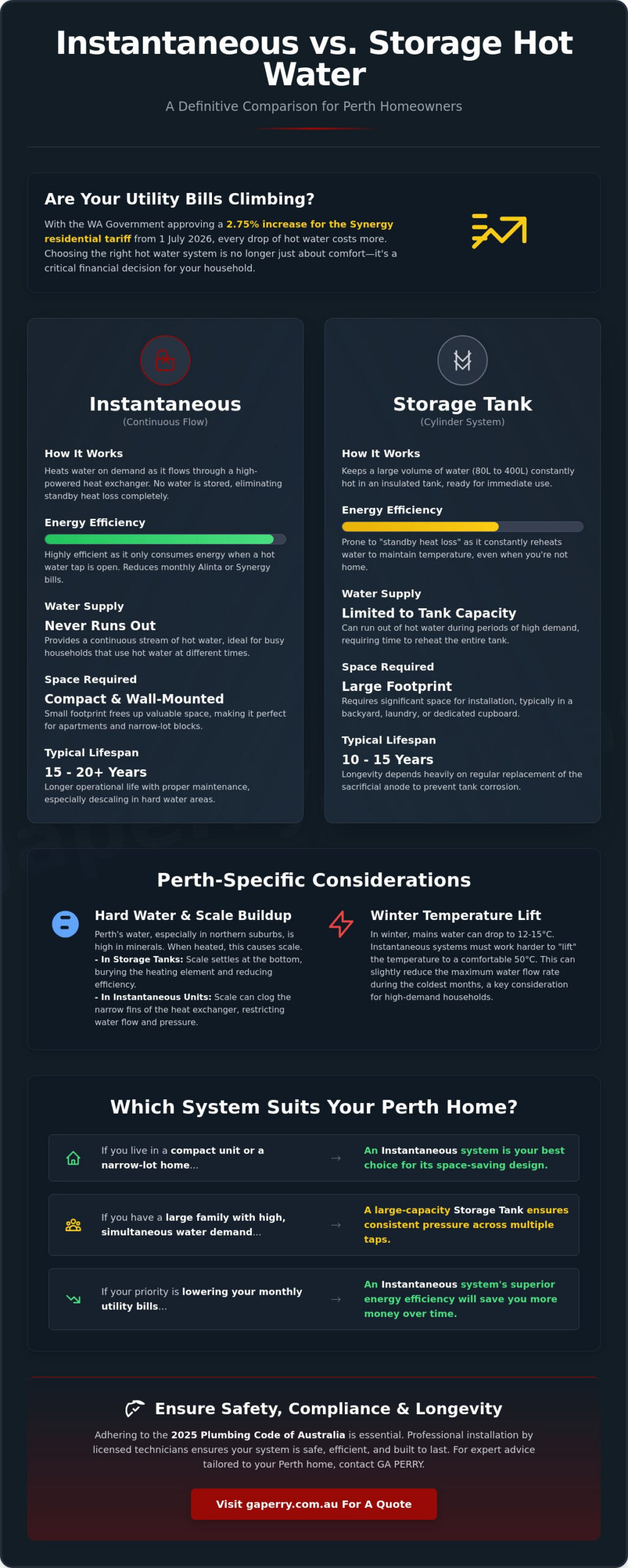
What if the “tried and tested” hot water tank in your backyard is actually the primary reason your Synergy bill keeps climbing? If you’ve ever been the last person in the family to shower only to find the water turning icy, you know that reliability matters just as much as cost. Deciding between instantaneous vs storage hot water isn’t just a technical choice anymore; it’s a strategic decision for your household budget. With the Western Australian Government approving a 2.75% increase for the Synergy residential tariff from 1 July 2026, every drop of heated water now carries a higher price tag.
You deserve a system that fits your lifestyle, whether you’re squeezing a unit onto a narrow-lot block or trying to lower your monthly outgoings. This guide provides a definitive comparison to help you choose a solution that promises a reliable supply for 15 years or more. We’ll explore how the new 2025 Plumbing Code of Australia impacts your installation and compare continuous flow efficiency against the familiarity of tank-based systems. By the end, you’ll know exactly which hot water replacement will keep your showers hot and your Alinta or Synergy bills manageable.
Key Takeaways
- Identify the fundamental operational differences between instantaneous vs storage hot water systems to select the most reliable technology for your family.
- Understand how Perth’s hard water conditions and mineral levels in the northern suburbs impact the durability of different heating components.
- Compare the long-term energy efficiency of continuous flow units against the traditional reliability of storage tanks to lower your monthly utility bills.
- Determine the best system for your property type, whether you require a space-saving solution for a narrow-lot block or a high-capacity tank for a large family home.
- Learn how adhering to the 2025 Plumbing Code of Australia during installation ensures your system remains safe, compliant, and efficient for years to come.
Understanding the Basics: Instantaneous vs Storage Hot Water
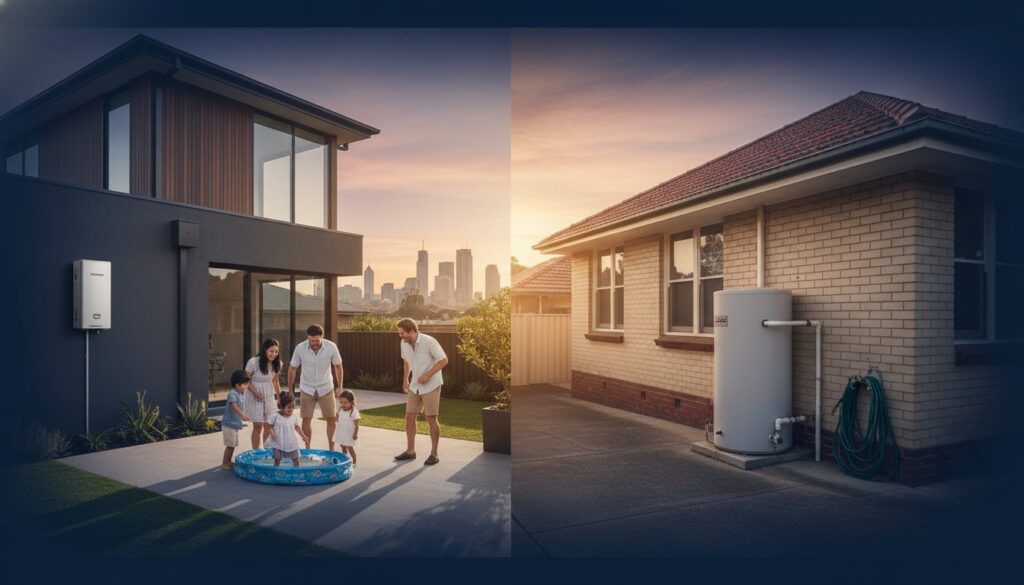
The choice between instantaneous vs storage hot water often comes down to how your household consumes energy and space. In established Perth suburbs, the large, cylindrical storage tank is a familiar sight in backyards. These systems act as a reservoir, maintaining a set volume of hot water so it’s ready the moment you turn a tap. Conversely, instantaneous systems, often called continuous flow units, represent a shift in technology. They don’t store water at all. Instead, they flash-heat it as it passes through the unit.
Understanding the physics of how water heaters work helps clarify why your utility bills might fluctuate. Whether you use gas through Alinta or electricity via Synergy, the method of energy transfer is what defines your experience. Storage systems focus on energy retention, while instantaneous systems focus on high-intensity energy transfer on demand. Each method has specific mechanical requirements that suit different types of Western Australian properties.
How Storage Hot Water Systems Work
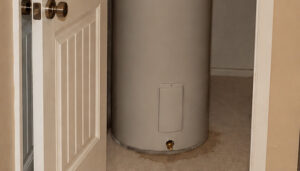
A storage system consists of an insulated internal cylinder, usually made of copper or vitreous enamel-lined steel. To protect the tank from Perth’s mineral-rich water, a sacrificial anode sits inside the tank. This rod corrodes so the tank doesn’t, making it a vital component for system longevity. These units operate on a “reheat” cycle. Sensors detect when the water temperature drops below a specific threshold, triggering the element or burner to fire up. This happens regardless of whether you’re at home or at work, ensuring a full tank is always available. Common Perth installations range from compact 80L units for apartments to 400L tanks for large families.
How Instantaneous Hot Water Systems Work
Instantaneous systems are frequently referred to as “continuous flow” because they provide a steady stream of heated water for as long as the tap remains open. When you turn on the hot water, a sensor detects the flow and ignites a high-powered gas burner or activates an electric element. This heat is transferred to the water through a component called a heat exchanger. Because there is no tank, these units avoid “standby heat loss.” You aren’t paying to keep 135 litres of water hot at 3:00 am while everyone is asleep. This efficiency is a primary reason many Perth homeowners are moving away from traditional tanks during their next hot water system replacement.
Perth-Specific Considerations: Water Quality and Climate
Perth’s unique environmental conditions play a decisive role in the lifespan and performance of your plumbing. While the discussion regarding instantaneous vs storage hot water often centres on energy bills, local water chemistry is the silent factor that determines whether your unit lasts ten years or twenty. Our metropolitan area relies on various water sources, including groundwater that can be high in mineral content. These minerals react differently depending on how you choose to heat your water.
The Impact of Hard Water on Your System
Hard water is a common challenge for Perth residents, especially those in the northern corridor. High concentrations of calcium and magnesium create “scale” when the water is heated to high temperatures. In storage systems, this sediment settles at the base of the tank. It can eventually bury the heating element or coat the sacrificial anode, causing it to dissolve much faster than expected. Conversely, in instantaneous units, scale buildup occurs within the narrow copper fins of the heat exchanger. This restricts water flow and forces the unit to work harder to transfer heat. If you find your hot water stopped working or the pressure has dropped, local sediment is a likely culprit. Regular maintenance and flushing are essential to prevent these minerals from shortening your system’s life.
Climate and Delivery: Does Perth Get Cold Enough to Matter?
Climate also dictates the “temperature lift” required from your system. Perth winters are relatively mild, but the water entering your home from the mains still drops to approximately 12-15°C between June and August. For a continuous flow unit to reach a safe and comfortable shower temperature, it must raise that water temperature significantly in a split second. This increased demand can slightly reduce the maximum flow rate during the colder months. However, the energy efficiency of tankless water heaters is still a major draw for Perth homeowners. These units don’t lose heat to the cold night air like a large outdoor tank does. Storage systems remain a popular choice for larger families who need consistent pressure across multiple bathrooms simultaneously, as the water is already heated and ready to go.
Choosing the right system for your specific suburb requires local expertise and an understanding of your household’s daily rhythm. If you are unsure about the water quality in your area or which technology fits your home best, consulting with a professional at GA PERRY can help you avoid a costly mistake and ensure your system is sized correctly for Perth’s conditions.
Direct Comparison: Cost, Efficiency, and Performance
When evaluating instantaneous vs storage hot water, the debate often moves from comfort to the hip pocket. Leading brands like Rheem, Rinnai, and Dux offer high-quality options for both technologies, but the initial invoice is only half the story. A storage system is frequently the most straightforward emergency replacement. If the footprint and pipework already exist, a new tank can be installed with minimal labour. However, switching to an instantaneous unit involves greater complexity. These systems require high-capacity gas lines and specific ventilation to meet the 2025 Plumbing Code of Australia. While the upfront labour is higher, the energy efficiency of tankless water heaters often justifies the shift for long-term homeowners. You can expect a quality storage tank to last roughly 10 to 12 years, whereas a well-maintained continuous flow unit can provide reliable service for up to 20 years.
Upfront Investment vs Long-Term Savings
Choosing a storage system replacement is usually the most cost-effective solution when a tank bursts suddenly. It avoids the need to resize gas pipes or rewire electrical circuits. However, you must account for “standby heat loss.” This occurs when the water in the tank cools down and requires reheating, even if nobody is using it. Over a year, this can add a noticeable amount to your Synergy bill. Instantaneous systems eliminate this waste by only heating water when a tap is turned on. Typical installation requirements for a transition to instant gas include upgrading to a larger gas pipe diameter, often 20mm or 25mm, and ensuring adequate ventilation and clearance from windows or doors.
Running Costs: Synergy and Alinta Perspectives
Running costs in Western Australia are heavily influenced by your provider. A thorough look at gas vs electric hot water reveals that Alinta gas rates generally remain more competitive for high-use households. This is particularly relevant as the Synergy Home Plan (A1) tariff is set for a 2.75% increase on 1 July 2026. For those with large electric storage tanks, using “Off-Peak” rates or solar PV can mitigate these costs. You can organise your storage system to act as a thermal battery, heating water during the day when solar production is at its peak. This effectively stores renewable energy for your evening showers and offsets the standby heat loss that occurs as the tank sits idle.
Performance is the final piece of the puzzle. Instantaneous systems deliver on the promise of endless hot water, which is a primary draw for many modern families. However, the flow rate is shared between all active outlets. If you run multiple showers at once, you might notice a slight drop in pressure. Storage systems avoid this by providing a high-pressure burst from the tank, making them a steady choice for homes with simultaneous high demand across several bathrooms.
Maintaining consistent pressure is a challenge in many environments beyond the home; for instance, in large-scale industrial water treatment, engineers explore Goulds Water Technology Pumps to ensure reliable flow and performance in demanding conditions.
The Decision Matrix: Which System Suits Your Perth Home?
Selecting between instantaneous vs storage hot water depends heavily on your property’s footprint and how your family uses water. Perth’s urban landscape has shifted dramatically over the last decade. We’ve seen a rise in narrow-lot homes and urban infill projects where every square metre of land is precious. In these environments, the physical size of the system is often just as important as its heating capacity. Beyond space, you must consider your household’s peak demand times. A single professional living in a Subiaco apartment has very different requirements than a family of five in a four-bedroom home in Canning Vale.
Lifestyle factors should dictate your choice. If your household tends to take back-to-back showers or frequently uses a large bathtub, the “recovery time” of a storage tank becomes a critical metric. Conversely, if your water use is sporadic, the standby heat loss of a tank represents a poor return on investment. Environmental considerations also play a role. While gas instantaneous units are far more efficient than old-fashioned electric tanks, many homeowners are now looking at heat pump storage as a way to lower their carbon footprint while maintaining high delivery volumes.
Best for Small Households and Modern Units
Instantaneous systems are widely considered the gold standard for Perth’s modern villas and apartments. Their compact nature allows them to be mounted on external walls, effectively reclaiming the side-path or laundry space that a bulky tank would otherwise occupy. This is a significant advantage for narrow-lot blocks where side-access is limited. These units also offer the benefit of “set and forget” digital temperature controllers. These allow you to lock in a safe temperature for children’s baths, preventing scalding and removing the need for manual mixing at the tap. For households of one or two people, the efficiency of only heating water when needed is hard to beat.
Best for Large Families and Traditional Suburbs
Large families with high-demand homes, typically those with three or more bathrooms, often find that storage systems provide the most reliable experience. While “endless” water sounds appealing, a standard instantaneous unit can struggle if two showers, a dishwasher, and a washing machine all run simultaneously. The flow rate is split between these outlets, which can lead to a noticeable drop in pressure or temperature. A large storage tank, particularly a modern heat pump or a high-efficiency gas unit, acts as a buffer. It ensures that the morning rush is handled without anyone getting a cold surprise. If your lifestyle involves frequent back-to-back showers or filling large soaking tubs, a high-capacity storage system remains a dependable choice.
If your current unit is showing signs of age or you’re ready to upgrade your efficiency, it’s time to act. Contact the team for a professional hot water system replacement to ensure your new system is perfectly matched to your Perth home.
Expert Installation and Maintenance with GA PERRY
GA PERRY has served the Perth community for over 125 years. This long-standing presence means we have encountered every possible plumbing configuration in Western Australia. When you are deciding between instantaneous vs storage hot water, the technical installation is just as vital as the unit you choose. Our team prioritises professional competence and legal compliance. We ensure every job meets the rigorous standards of the 2025 Plumbing Code of Australia. We also take pride in our disciplined approach to service. This includes a strict commitment to leaving your home clean and tidy once the installation is complete.
Why Sizing Matters for Your Hot Water
Selecting a unit based on the purchase price alone often leads to long-term frustration. Undersizing an instantaneous system is a common mistake that compromises your comfort. If the flow rate is too low for your household, you will experience temperature fluctuations whenever a second tap is opened. Conversely, oversizing a storage tank means you are paying Synergy to heat water that simply sits idle. Our licensed plumber Perth team uses precise calculations to determine your peak demand. We evaluate your bathroom count, appliance usage, and family habits to find the perfect balance for efficiency and reliability.
The Peace of Mind of 24/7 Service
Hot water emergencies rarely occur at a convenient time. Whether it is a burst tank at midnight or a failing heat exchanger on a Sunday morning, you need a “sure thing” in an industry where quality can be inconsistent. When these situations strike, having access to a trusted emergency hot water repair Perth service means you won’t be left without hot water for long. We provide 24/7 emergency support across the entire Perth metropolitan area. Our on-time guarantee reflects our respect for your schedule. We arrive when we say we will, equipped to handle the situation immediately. Our expertise extends beyond major installations. We manage everything from expert leaking tap repair to complex gas leak detection and full system replacements.
Proper maintenance is the key to ensuring your system lasts for its intended lifespan. We ensure all new installations include correctly fitted tempering valves. These are required by WA law to prevent scalding by limiting bathroom water delivery to 50°C. By choosing a seasoned master tradesman, you ensure your investment in instantaneous vs storage hot water is protected by ironclad workmanship and time-tested methods. We remain a dependable guardian of your home’s essential systems, ready to act whenever you need us.
Secure a Reliable Hot Water Solution for Your Perth Home
Choosing the right system involves more than just picking a brand. It requires a clear understanding of your household’s daily rhythm and the specific water conditions in your suburb. Whether you prioritise the space-saving efficiency of a continuous flow unit or the high-volume reliability of a traditional tank, the instantaneous vs storage hot water debate is ultimately about finding the best fit for your lifestyle and budget. Ensuring your system is correctly sized and compliant with the 2025 Plumbing Code of Australia will protect your investment for years to come.
GA PERRY has been a dependable guardian of Perth’s essential systems for over 120 years. Our licensed and insured local tradespeople are available for 24/7 emergency plumbing and gas fitting, providing the reassurance you need during a domestic crisis. We pride ourselves on being a “sure thing” in an industry where quality can be inconsistent.
Get a Professional Hot Water Assessment from GA PERRY Today
Take the guesswork out of your next upgrade and enjoy the peace of mind that comes with a perfectly heated home.
Frequently Asked Questions
Is it cheaper to run an instantaneous or storage hot water system in Perth?
Instantaneous systems are generally cheaper to run because they only consume energy when you turn on a tap. Traditional storage tanks lose heat through the cylinder walls throughout the day and night, requiring constant reheating to maintain temperature. With the Synergy residential tariff increasing by 2.75% on 1 July 2026, the efficiency of an instant system offers a practical way to manage rising utility costs.
Can I switch from a storage tank to an instantaneous system easily?
Switching requires a professional assessment because the infrastructure needs differ between the two technologies. Most instantaneous gas units require a larger gas pipe diameter to handle the high-intensity heating process. You will also need a licensed plumber to install a weatherproof power point for the electronic ignition and ensure the new unit complies with the 2025 Plumbing Code of Australia regarding ventilation and clearances.
Do instantaneous hot water systems have lower water pressure?
You might notice a slight drop in pressure if multiple hot water taps are used at the same time. While a storage tank provides a consistent flow from a pre-heated reservoir, an instantaneous unit must limit the flow rate to ensure the water reaches the target temperature. Sizing the unit correctly for your home’s specific number of bathrooms is the best way to prevent noticeable pressure drops during peak times.
How long does a typical hot water system last in Perth’s conditions?
A standard storage tank typically lasts between 10 and 12 years in Western Australia. In contrast, a high-quality instantaneous system can provide reliable service for 15 to 20 years with regular maintenance. Perth’s hard water can lead to mineral buildup, so replacing the sacrificial anode in storage tanks every few years is essential to reach these lifespan targets and avoid premature tank failure.
What size hot water storage tank do I need for a family of four?
A family of four typically requires a 135L to 170L gas storage tank or a 250L to 315L electric unit if you are using off-peak tariffs. This capacity ensures there is enough volume for back-to-back showers and appliance use during the morning rush. Choosing the right capacity prevents the common pain of running out of hot water mid-shower while keeping your energy consumption manageable.
Are instantaneous hot water systems truly “endless”?
Yes, these systems provide a continuous flow of hot water for as long as the tap remains open. Unlike a storage tank that can be emptied, an instant unit heats the water on demand. When comparing instantaneous vs storage hot water, the “endless” feature makes continuous flow an ideal choice for large families or households where multiple people shower in quick succession.
Do I need a power point for a gas instantaneous hot water system?
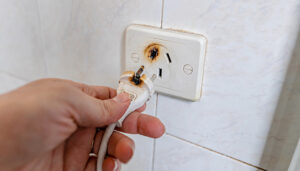
Most modern gas instantaneous units require a standard 10-amp weatherproof power point. The electricity powers the electronic ignition, the digital temperature controllers, and the internal sensors that detect water flow. If you are switching from an old storage tank that didn’t require power, a licensed professional will need to install a new circuit to ensure the system functions correctly and safely; for these types of residential wiring upgrades, Electrical Repair 4U offers the specialist support needed to complete the installation.
Why does it take longer for hot water to reach the tap with an instant system?
The slight delay is caused by the unit needing a few seconds to ignite the burner and reach the target temperature once it senses water flow. The cold water already sitting in the pipes between the unit and your tap must also be pushed out before the freshly heated water arrives. This “wait time” is a minor trade-off for the significant energy savings and the endless supply provided by continuous flow technology.